

Bridging the Corporate Governance Gap in Impact Enterprises
On 19th November 2025, Biniyog Briddhi hosted the fourth edition of its Peer-to-Peer (P2P) Exchange Event, convening startup founders, impact entrepreneurs, investors, and ecosystem enablers to unpack one of the most pressing yet often overlooked topics in the startup journey — corporate governance.

Building resilient and investor-ready enterprises
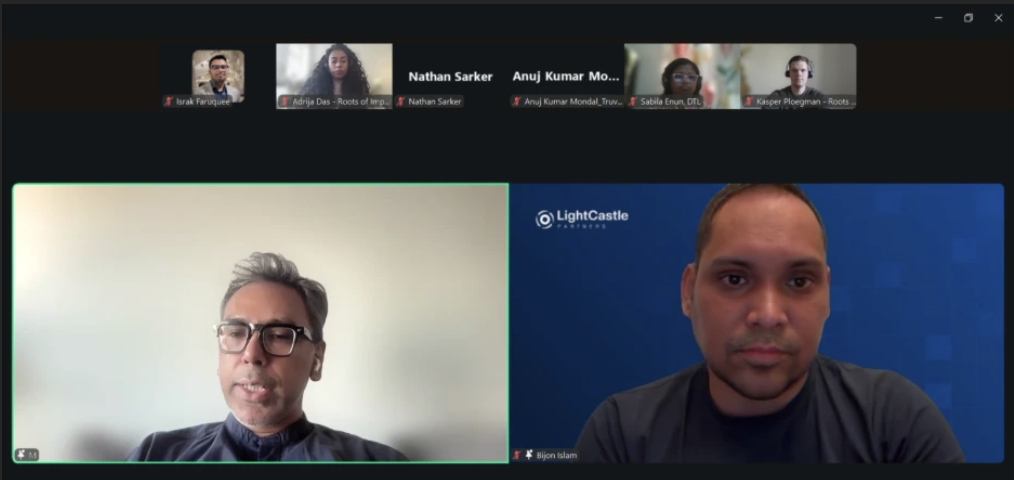
The session featured Mustafizur Rahman Khan, Partner at IDLC Venture Capital Fund I, who shared grounded perspectives on why strong governance frameworks are indispensable for startups and impact enterprises. Opening remarks were delivered by Adrija Das, Manager of Impact Intelligence and Education at Roots of Impact, with the discussion moderated by Bijon Islam, CEO of LightCastle Partners.
Setting the stage, Mustafizur underscored that governance is not about control but about creating discipline and accountability that safeguard an enterprise from operational, legal, and compliance-related risks. He noted that governance failures — especially around finance, taxation, HR, and regulatory filings — can stall growth, delay audits, and in severe cases, threaten business continuity. For investors, such lapses are red flags that undermine credibility and confidence.
“Governance is not a box to tick; it is the foundation that makes your company resilient and trustworthy in the eyes of investors.”
— Mustafizur Rahman Khan, Partner, IDLC Venture Capital Fund I

Re-thinking boards as strategic allies
A recurring theme in the discussion was the misconception that building a board dilutes founder control. Mustafizur clarified that an effective board functions as a guide, not a controller — providing strategic oversight, helping founders identify blind spots, and supporting decision-making in finance, HR, and legal areas.
He advised founders to prioritise value alignment and expertise when recruiting board members rather than offering equity as default compensation. “A board should help you see blind spots you cannot see yourself, not take your company away from you,” he remarked, emphasising that the right board composition can accelerate learning and resilience for early-stage enterprises.
Key insights from the session
- Governance as growth enabler: Strong governance structures attract investors, improve decision-making, and foster long-term sustainability.
- Common compliance pitfalls: Missed VAT/tax filings, delayed audits, and HR or legal lapses continue to undermine investor confidence in many startups.
- Practical, low-cost solutions: Approaches such as fractional hiring, outsourced compliance, and shared legal or accounting resources can help startups meet obligations efficiently.
- Purpose-driven boards: Effective boards serve as strategic partners and sounding boards, ensuring mission alignment and offering operational expertise without overreach.
- Preventing mission drift: For impact-focused enterprises, regular quarterly board meetings and transparent communication help preserve social objectives alongside financial goals.
Addressing real-world founder concerns
In the interactive Q&A segment, founders raised questions on when and how to begin establishing governance systems. Mustafizur stressed that governance should start from day one, even if initially with simple documentation and processes in finance, HR, and compliance. Early adoption signals credibility and prevents costly mistakes as the company scales. When asked how to balance compliance costs with operational priorities, he proposed shared resources and fractional talent models — such as hiring part-time CFOs or legal advisors — as cost-effective ways to build governance capacity.
Responding to concerns about losing control to a board, he reiterated that founders remain in charge: “Boards exist to guide, not take over. The right members bring experience and perspective that protect your company’s future.”

Finally, the discussion turned to mission preservation for impact-driven startups. Mustafizur likened investor-founder relationships to a marriage — where shared values and long-term alignment are essential for sustaining both impact and business performance.
Addressing real-world founder concerns
The session concluded with an energetic exchange among participants, who agreed that governance should be seen not as an administrative burden but as a strategic advantage. Even modest, well-planned governance steps — like quarterly board reviews, basic compliance tracking, or a documented HR policy — can significantly enhance investor trust, operational stability, and long-term impact.
As Bangladesh’s startup ecosystem matures, embedding governance early will be vital to building resilient, investment-ready, and socially conscious enterprises that can scale sustainably.
About the Biniyog Briddhi Programme
B-Briddhi is a gender-inclusive programme supporting a thriving impact ecosystem in Bangladesh where impact enterprises can grow and scale. This programme is supported by the Embassy of Switzerland in Bangladesh and implemented by Roots of Impact and LightCastle Partners.